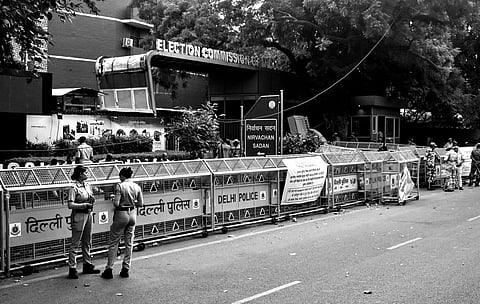

THE heavy handed and oppressive measures taken against protesters on October 10 demanding CEC Gyanesh Kumar’s resignation gave an impression that those operating Indian State apparatus waged a war against “We the People.” To deal with the call of the Cockroach Janata Party (CJP) to protest in Delhi on 10th October asking Kumar to quit office, Delhi police turned the national capital city into a fortress by deploying more than 50,000 security forces to prevent people to exercise their constitutionally guaranteed fundamental right to assemble without arms and peacefully protest. Apart from the deployment of massive police and paramilitary personnel and placement of barricades on several routes and big iron nails on several key roads, the Government of India cancelled rail services to Delhi, shut down 45 metro stations in the city, blocked internet services and people in large numbers were detained.
Shutting Down Internet Violates Fundamental Right
It is salutary to recall that the Supreme Court in January 2020 ruled that "Freedom of speech and expression includes the right to internet within Article 19." So the sweeping police clamp down to prevent people from protesting and the suspension of internet services have deprived people of their fundamental rights.
Abhijit Dipke, chief of CJP and two of its leaders Ashutosh Ranka and Saurav Das were detained by Delhi police and taken into custody from inside the aircraft on their arrival at Delhi airport. It was reported by media that through the day on 10th October around 7,000 people were detained across Delhi following the imposition of citywide lockdown and massive crackdown to foil the leaders of Cockroach Janata Party and students affiliated to left parties to protest.
Successful July Protest Scared The Regime
In July this year the determined protests of CJP and left organisations at Jantar Mantar against the NEET exam paper elicited unprecedented participation of public disregarding brutal police action, including firing of pellet guns at protestors, and it culminated in the fulfilment of their demand when Union Education Minister Dharmendra Pradhan resigned. Keeping in mind that huge and successful protest the Delhi police and Union Government shut down the city even before the protests could begin this time.
Prominent among thousands detained by Delhi police were Ex-Chief Ministers Mamata Banerjee, Arvind Kejriwal and Pinarayi Vijayan and Manik Sarkar.
Such extreme measures taken to lock down the city and take coercive measures were not even taken during emergency imposed during June 1975 and March 1977 by Indira Gandhi Government.
Eruption of Protests Disregarding Clamp Down
In spite of such a muscular approach adopted by the Union Government and Delhi police, protests erupted in several places close to Jantar Mantar. Such dogged determination of young protestors to cross police hurdles and come to sites, one or two kilometres away from Jantar Mantar, to organise flash protests demanding Gyanesh Kumar’s resignation stunned the personnel of security forces. When Neha Vora of AISA and a student of JNU gathered at Delhi Hatt and INA to organise protests demanding Kumar’s resignation and scrapping of SIR she told the sizeable gathering, “Isko Jantar Mantar Bana Dete Hain,” “Let us make it Jantar Mantar.” The protestors cheered and shouted slogans asking Kumar to quit. As the protestors marched ahead and organised their protest on SafdarJung Airport fly over it signalled the message that the undying spirit of youth to exercise their constitutional right to protest remained undimmed. Even though eventually they were detained by police, protests erupted in several other parts of Delhi. Popping up of protests across the city testified to the resolve of Gen Z that they would uphold the Constitution come what may.
Protests to Continue
The CJP leadership and left parties have announced that protests would continue every day beginning from October 11.
The detained CJP leaders Abhijit Dipke, Ashutosh Ranka and Saurav Das were released on October 11, on the orders of the Executive Magistrate from Delhi Cantt Police station. “A bail bond as Surety Bond of Rs 50,000 was filled for maintaining peace and good behaviour, for a period of one year, and they were released by the SEM Court,” the police said in the statement.
Ajinkya Shinde, its national organisation in-charge, said, “The government must have thought we will return home after the detentions today. This fear on the part of Modi, Shah shows we have won half the fight."
Impactful YouTube content creator and influencer Dhruv Rathee was also taken away by police from his Gurgaon residence and he said that “he was kidnapped, not detained or arrested”.
CJP Leaders are reported to have said, “Modi as PM is an 'Embarrassment to India', “CEC a 'Traitor.'
Over 200 NLSIU Alumni in a statement posted at X condemned ‘police action’ taken against protestors on October 10 including the ‘detention and physical manhandling’ of NLSIU alumni and Senior Advocate Shadan Farasat, https://x.com/LiveLawIndia/status/2109172425027981375.
‘The state cannot arbitrarily detain – even during an Emergency – those who are exercising these rights in the manner seen when over 10,000 people have reportedly been detained across the country’
SC Notice and Order
Meanwhile the Supreme Court issued notice to Delhi police, Centre in contempt of court plea and sought reply notice by Tuesday and ordered that in interim ensure free and safe movement of lawyers, journalists, and other professionals. It also directed that public movement should be ensured subject to public order and internet connection should be available undisturbed.
Among others, SC also directed:
Subject to public order review positioning of barricades keeping in mind safety and smooth movement of people; there should not be illegal detention particularly beyond the area where section 163 BNSS is imposed; take down 163 BNSS notice from around supreme court or any other court of law…so there is no apprehensions with regards access to justice.
Thankfully on October 11 the Supreme Court ordered that there should be no illegal detention of those assembling peacefully added that the restrictions on public assembly and movement must comply with the conditions laid down under Article 19(2) of the Constitution, which permits reasonable restrictions on freedom of speech and expression on specified grounds, including public order.
Fierce Determination to Protest
The determination of protectors to protest by following the constitutional mandate enshrined in the chapter on fundamental rights clearly prohibiting the State not to encroach the freedom of people has to be treated as sacrosanct. None can violate it, no third degree repression on the part of the State controlled by Modi regime can deter people to uphold the Constitution and its mandate to protest and exercise freedom of speech. In this context it is worth recalling what Mahatma Gandhi wrote in his article, “An Appeal for Peace,” published in the Harijan on February 23, 1934. “None but tyrants,” he remarked, “are reported by history to have succeeded in enforcing their will against all others, and that they did to their own utter destruction.”
Today the people of India specially the youth are steeled with courage and given their resolve to save the Constitution the raw police and penal measures, representing the will of the tyrant, to repress them and muzzle their spirit would fail. The cautionary words of Gandhi uttered in 1934 assume greater relevance for the rulers of India of 2026.
